Richard Diebenkorn
American, 1922–1993
About Richard Diebenkorn
Richard Diebenkorn (1922–1993) was born in Portland, Oregon, and began drawing at a young age, after his family moved to San Francisco. His drawing was encouraged by his grandmother, Florence Stephens, who was a lawyer, painter, and a poet. In 1936, she brought him to see a Vincent van Gogh retrospective at the California Palace of the Legion of Honor. Drawn to the striking colors and distorted images, this exhibition, and later, a book of Cezanne’s paintings, changed Diebenkorn’s perceptions of art’s possibilities
In 1940, Diebenkorn enrolled at Stanford University expecting to study law, business, or medicine. After the bombing of Pearl Harbor in December 1941, he enlisted and enrolled in some art classes, studying with Daniel Mendelowitz, an important early mentor. During this time, Diebenkorn also began a relationship with Phyllis Gilman, who was enrolled in a Navy-sponsored drafting course, and the couple married around the same time Diebenkorn was called to active duty and transferred to University of California, Berkeley (UC Berkeley). At Berkeley, he studied with Erle Loran, Worth Ryder, and Eugene Neuhaus before being sent off for bootcamp in South Carolina in 1944.
After bootcamp, Diebenkorn made his way to Quantico, Virginia for further training. He and Phyllis spent lots of time at museums in the Washington, DC, area, including the National Gallery of Art, the Corcoran, and the Phillips Memorial Gallery (now the Phillips Collection), where Diebenkorn frequently visited Henri Matisse’s Studio, Quai Saint-Michel. The artist would remain a major influence throughout Diebenkorn’s career.
In 1945, Diebenkorn was transferred to Camp Pendleton in California, but was never deployed, and after being discharged, he and his family went to live with his parents in Atherton, California. He enrolled at the California School of Fine Arts (CSFA, later called San Francisco Art Institute) where he studied with David Park, who had greatly impacted his work, and received a grant to move to New York at the end of 1946.
In 1947, after nine months in New York, Diebenkorn moved his family back to California to teach at CSFA. While the Diebenkorns were in New York, CSFA’s new director, Douglas MacAgy, and an influx of GI Bill students and notable faculty had greatly changed the school’s atmosphere. Through his position as an instructor, Diebenkorn was given a solo exhibition at the Palace of the Legion of Honor in 1948 at only twenty-six years old.
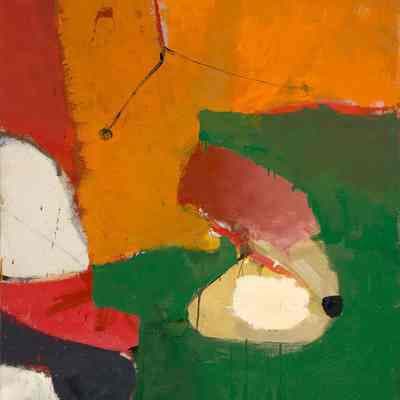
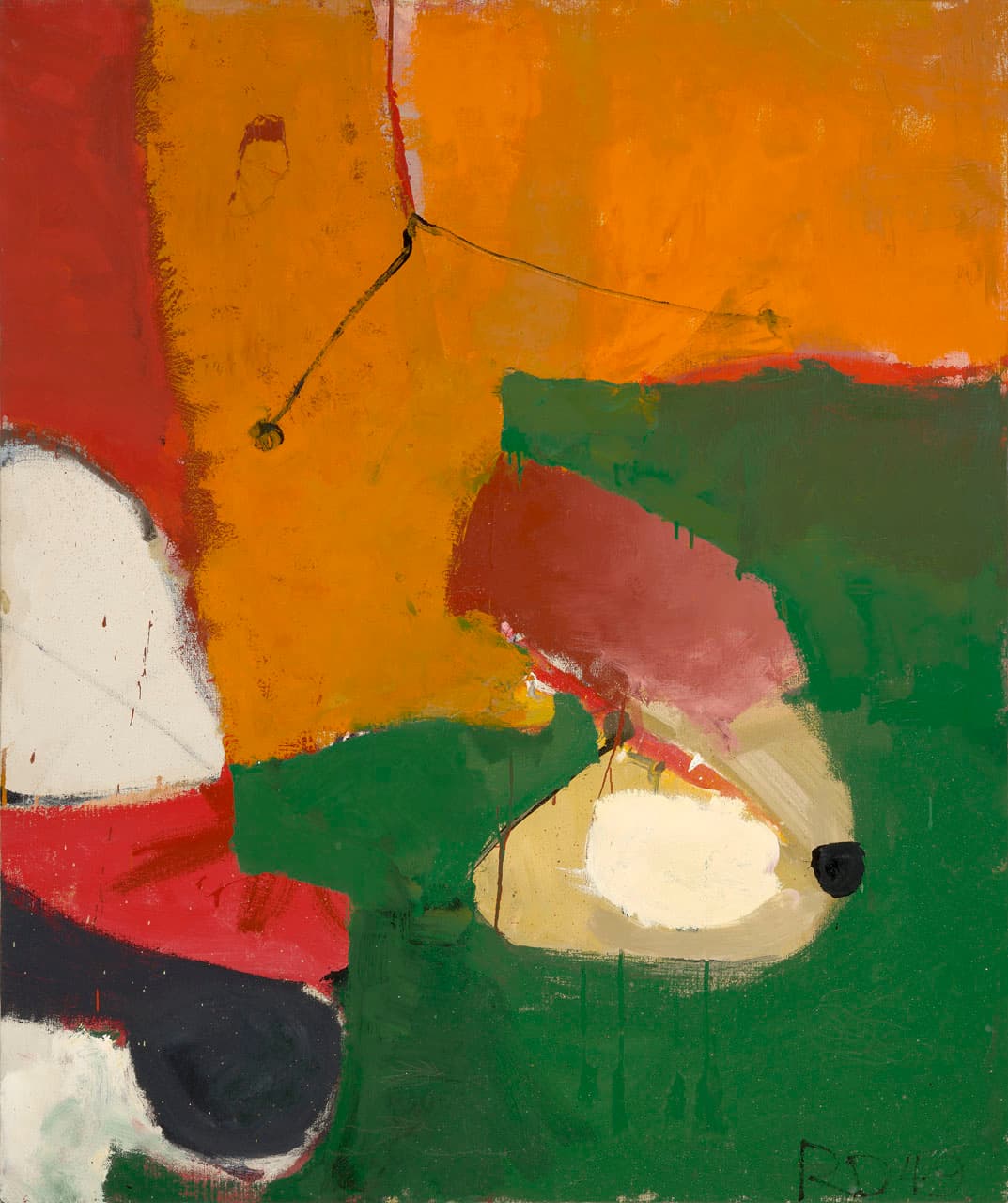
As the climate of CSFA continued to shift and the influx of GI Bill students ended, the school began to remove instructors. After the firing of Ed Corbett and Hassel Smith, Diebenkorn decided to resign in 1949 and moved his family to New Mexico to pursue an MA at the University of New Mexico (UNM) in Albuquerque. Diebenkorn had chosen the school for New Mexico’s landscape, as UNM, unlike CSFA, was not particularly focused on post-war abstraction. After completing his thesis, a body of work knows as the Albuquerque paintings, Diebenkorn took an additional year of classes before moving his family back to California to live with Phyllis’ stepfather at his ranch near Pomona.
In 1952, Diebenkorn accepted a position at University of Illinois (later the University of Illinois Urbana—Champaign) where he would teach for a single academic year. The summer before the Diebenkorn family moved east, Diebenkorn saw the exhibition Henri Matisse in Los Angeles. The exhibition, which was organized by the Museum of Modern Art in New York and traveled to California, caused a major shift in his work. Over the next few years, Diebenkorn’s paintings became more colorful, having more saturated shapes simultaneously on the canvas compared to the muted palette of his Albuquerque paintings.
The family briefly lived in New York City before moving back to California, settling in Berkeley in 1953 while Phyllis attended UC Berkeley for her PhD in Psychology. Diebenkorn began painting full time, and in 1955, he started participating in weekly figure drawings sessions with David Park, Elmer Bischoff, Paul Wonner, and William Theophilus Brown, enjoying the relaxed setting and what he described as “mindless” work. His paintings soon became more figurative, and he had moved away from abstraction completely by 1956. Diebenkorn started teaching at California College of Arts and Crafts in 1955, where he remained until 1958. He then took a year off, again focusing only on painting, before returning to teaching and ended up at the renamed San Francisco Art Institute (SFAI) in 1959.
Diebenkorn left SFAI in 1963–1964 for a year-long position as artist-in-residence at Stanford University. After a trip to the Soviet Union, where he saw confiscated Matisse paintings at the State Hermitage Museum and the Pushkin State Museum of Fine Arts, he returned to teaching at SFAI in the fall of 1965 before moving south with Phyllis to Santa Monica to accept a position at University of California, Los Angeles, where he would teach from 1966 to 1973.
After the move to Santa Monica, Diebenkorn increased the scale of his paintings, making canvases as large as he could to still get through doorways. Initially, his work was still representational, but within a year he had moved back to abstraction. In 1967, Diebenkorn started his famed Ocean Park paintings, named after the neighborhood in which his studio was located. The paintings were a new territory of abstraction for him—rather than return to loose, expressionist paintings, he aimed to create controlled compositions that achieved all his ideals at once. In 1969, Diebenkorn had a solo exhibition, New Paintings of Richard Diebenkorn, at the Los Angeles County Museum of Art. The exhibition was curated by Gail Scott and was the first to feature the Ocean Park works.
In 1988, Diebenkorn and Phyllis moved to Healdsburg, California, where he mainly made works on paper. In 1989, Diebenkorn contracted an infection after having corrective surgery for a damaged aortic valve. After experiencing worsening health problems, he and Phyllis moved back to Berkeley in 1992 to be closer to medical facilities. Diebenkorn passed away from pulmonary failure in 1993.
Notes:
Jane Livingston. Richard Diebenkorn Foundation, “Biography.” Accessed on October 10, 2025. https://diebenkorn.org/the-artist/biography/
Oral history interview with Richard Diebenkorn, 1985 May 1-1987 December 15. Archives of American Art, Smithsonian Institution.
Richard Diebenkorn Foundation, “Artist Chronology.” Accessed on October 10, 2025. https://diebenkorn.org/chronology/
Shields, Scott A. Richard Diebenkorn: Beginnings, 1942–1955. Pomegranate Communications, Inc., 2017.